

The ACO’s Journal of Orgonomy is now on Substack featuring free articles from the Journal. Learn about Medical Orgone Therapy, Social Orgonomy, and Functional Thinking.
Peter A. Crist, M.D.
Introduction
Wilhelm Reich formulated basic concepts about human emotional functioning and its pathology. These concepts form the basic framework of medical orgonomy, which guides the orgone therapist in the treatment of his patients. Central among these concepts are the function of the orgasm; an understanding of character; the "red thread" of the character; an understanding of somatic armor; the three basic layers of emotional structure; genitality; and orgone energy as the life energy. These concepts and their practical application distinguish medical orgonomy from all other approaches to human emotional problems. Each of these concepts merits an expanded discussion beyond what has previously been presented in the orgonomic literature.
This series of articles, however, will focus on a detailed definition and discussion of only one of these: the three layers of emotional structure. We will see how this one concept brings a functional understanding to the medical sciences as well as to the social sciences. We will explore its application to important areas of the biological sciences and even see it lead us into the realm of the physical sciences as we consider possible roots of the three layers in basic physical orgone energy functions.
While the concept of the three layers of emotional structure has great practical and theoretical value, there has been surprisingly little discussion of it in the orgonomic literature. In Character Analysis (1), Wilhelm Reich's first major medical-psychiatric work, published in 1933, he describes general aspects of the layers of emotional structure, but it was not until 1945 in the preface to the third edition of his major sociological work, The Mass Psychology of Fascism (2:vii-viii), that he first published the concept of three distinct layers of emotional structure in its fully developed form. This concept was then briefly expanded upon by Elsworth F. Baker in Man in the Trap (3:61-63).
We will discuss how an understanding of these three layers emerged from an exploration of the difference between personality and character, but a note about the value of theory is in order before proceeding.
A Note on Theory
A theoretical concept is useful to the extent that it represents a functional energetic reality. Contact with these energetic realities, though, must emerge from experience. In clinical practice, one may provide help through instinctive contact with the energetic realities in one's patients, even without a clear conceptual framework. The theoretical concepts, however, guide and focus our views of patients and therefore our approach to them. Optimally then, a therapist has good instinctive contact focused through clearly defined concepts1.
1 Because the meaning of words are often distorted by idiosyncratic associations, explicit definition of concepts is essential for clear thinking and clear communication. (An exploration of this will be made elsewhere in an expanded discussion of functional linguistics.)
The mutual interdependence of theory and practice are succinctly stated by Reich:
In our work, theory and practice are inseparable. An erroneous theoretical position must create an incorrect technique, and an incorrect technique must lead to erroneous theoretical concepts. (italics in original) (3:297)
Where theory does not match practice, it is necessary to look at both more closely. This can then lead to refinements in each. The history and development of orgonomy is a tribute to this process. Examples abound, but we cite here just a few:
(l) Under Reich's direction, the members of the Technical Seminar of the Vienna Psychoanalytic Society in the 1920s continually held the theory of psychoanalysis up to the light of clinical practice. From this a deeper theoretical understanding of character and the technique of character analysis emerged.
(2) The formulation of the function of the orgasm and a redefinition of healthy sexuality emerged from the conflict between the theory of the sexual etiology of neurosis and the then prevailing view of what constituted healthy sexuality.
(3) Likewise, the discovery of the biological orgone emerged from the conflict between the theory of a bioelectric basis for charge in the organism and obvious discrepancy between this theory and the actual energy forces at work.
A theory may be compared to a map. A map is not the territory, but it is a valuable tool for the exploration of the territory. When actually driving, one can not spend much time looking at a road map. One must remain in contact with the changing conditions of the road. In order to stay on course, one must hold a mental image or have an instinctive sense of the map. Likewise, in clinical practice the therapist must maintain contact with the moment-to moment condition of the patient and also have an image or sense of the theoretical framework. Such a framework includes a specific diagnosis and an understanding of the particular structure of the patient.
Personality and Character
My interest in the concept of the three layers of emotional structure was sparked several years ago when a group of medical students on the consultation service where I teach raised questions about how it was that character could result only from traumas during childhood development. They had just finished a clinical rotation in the newborn nursery and had observed that each baby had his or her own individual way of behaving right from birth. The discussion did not resolve whether these individual differences were the result of inborn personality or character, but led to attempts to define each more clearly.
The words "personality" and "character" are used widely in general psychiatry and orgonomy. Based on previous uses and associations, everyone has a "sense" of what they mean. However, on closer examination, it becomes clear that this "sense" is often personal or idiosyncratic, and as a result the terms are used without clear differentiation or specificity.
In his original description of the three layers, Reich uses the terms "character" and "personality" at times specifically and at other times almost interchangeably (2). Baker does likewise:
The second or great middle layer is usually very complex; many sublayers pile one on another until a social adjustment has been reached which is presented as the social facade or personality. The personality is, then, the end result of all the social and educational restrictions placed upon the original healthy core. The social facade contains one (sometimes more) basic character trait as its means of meeting the environment. (italics mine) (3:62-63)
Character and personality: Does each represent a distinct functional reality? If so, what? How can we define each specifically so that we can have clarity in our communications?
My discussion with the medical students prompted me to look at the definitions of "personality" and "character." The linguistic tool of evaluating word roots (4) helped to clarify their definitions and, therefore, the concepts associated with them. "Personality" comes from persona, from the Etruscan phersu, "mask," used by an actor in ancient dramas. "Character" comes from kharesien, "to mark or brand," from the Indo-European, gher- "mark or brand" (gash is the only other common English word from this root). (5) These roots give the image of character as layers of emotional scarring resulting from trauma.
The words "character" and "personality" are used widely and have taken on meaning and connotation broader than their original root meanings. The common usage in our language suggests an intuitive feeling for a distinction between personality and character, even clearer than their use in psychiatry and psychology. We often hear people say, "Shakespeare had a remarkable understanding of human character." The statement, "Shakespeare had a remarkable understanding of human personality," conveys but a fraction of the depth of the first statement. The difference between the two terms are even more clearly illustrated by the statement: "He has a lot of personality," as opposed to "He has a lot of character." Character is clearly a deeper, more solid and fundamental aspect of human function.
The work of Stephen Covey, author and management consultant, clearly expresses this distinction. His use of "character" expresses the positive implications that the word has taken on in our language. He notes that in the first 150 years of U.S. history, the focus of self-improvement and popular psychology was on what he calls the "Character Ethic." This emphasized such qualities as "integrity, humility, fidelity, temperance, courage, justice, patience, industry, simplicity, modesty and the Golden Rule." In the next 50 years:
... shortly after World War I the basic view of success shifted from the Character Ethic to what we might call the Personality Ethic. Success became more a function of personality, of public image, of attitudes and behaviors, skills and techniques, that lubricate the processes of human interaction. This Personality Ethic essentially took two paths: One was human and public relations techniques, and the other was positive mental attitude (6:18-19)
Nature
These clarifications still leave unresolved the question of which word best describes the qualities seen in babies at birth. A satisfactory specific designation for these qualities was not clear until Dr. Richard Schwartzman used the statement, "Babies are all born with their individual natures." (7) The linguistic root of "nature" is Greek gnatus, "birth," from Indo-European gene, "birth" (also the root of genital, genesis, genetic, genuine and many others). (5)
However, in common usage in our language, "human nature" usually refers to the typical ways humans react. Armoring developed thousands of years ago and what is now called "human nature" we understand to be the result of the interaction between natural core and secondary layer impulses.
We are stirred by Shakespeare's plays because he so vividly shows us the struggles between the healthy core and the destructive secondary layer. His tragedies portray human conflict in which strong deep core impulses are overwhelmed and destroyed by the secondary layer. His comedies depict situations in which the deep natural impulses triumph. His histories depict both.
As more specific definitions emerged, it became clear that innate individual nature, character, and personality each describe functions within the realms, of respectively, the core, the secondary layer, and the facade. (Diagram 1.)
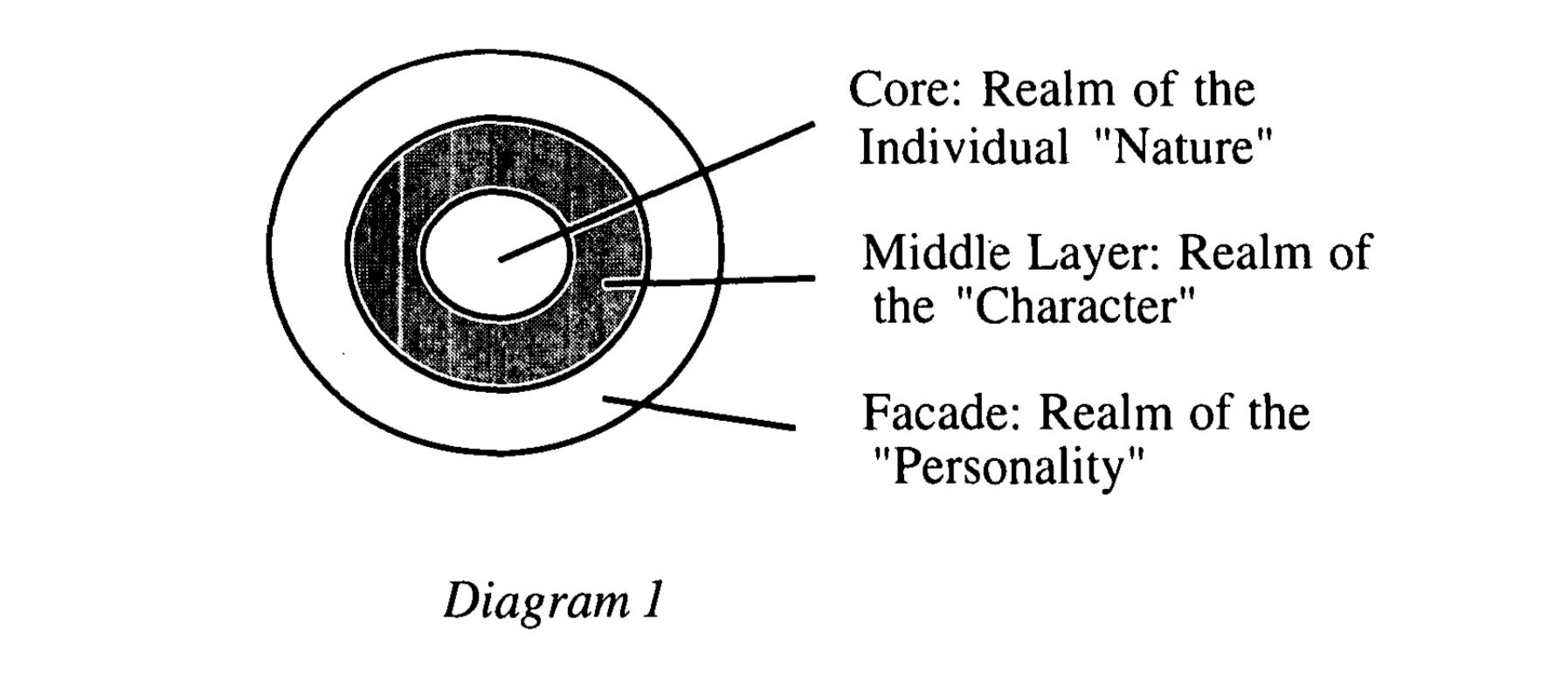
While "nature," "character," and "personality" have assumed broader meaning in their general use in our language, I suggest that we develop specific technical definitions which are implied by their linguistic roots.
This insight about the parallel between the three layers and the realms of nature, character, and personality led to modifications in my view of patients and refinement in my conduct of therapy. Further development of these concepts emerged from discussions of basic theory in the teaching of the College's didactic course for medical orgonomists, in discussions in our clinical training seminars, and in supervision of orgonomists-in-training. The various insights that emerged is the subject of this series of articles. Many of these ideas will be presented here in preliminary form in the hope that doing so will lead to clarification by further study and research. Ideally, such clarification of concepts can lead to practical steps to prevent neurosis and improve our ability to help patients overcome neurotic problems that have prevented them from developing the full potential that is their natural birthright.
The functions of the three layers of emotional structure
While it is valuable to examine the functions of each layer and differentiate them from one another, it is essential that we keep in mind that an organism functions as a unity with an integrated interplay between the ]ayers. For the purpose of clearly identifying the distinct functions, however, we will at times treat the ]ayers as more separate than they are in reality.
We will next examine the functions of the ]ayers in both neurosis and health. The differentiated functions of each layer are more obvious in neurosis when the unitary functioning of the organism is disturbed. We therefore begin our discussion here.
In Neurosis
Preliminary definitions of the function of each emotional layer has emerged from an examination of the functional reality behind the terms. The facade-the realm of the personality-functions to meet the world and keep in check the destructive drives of the secondary layer. The secondary layer-the realm of the character-functions to bind up the energy of the core that cannot be expressed and discharged directly. The individual nature-the realm of the core-simply functions in living.
The personality consists of all the means the individual has at his disposal to both keep in check the destructive drives of the secondary layer and to fend off anything from the outside world that would stir them up.
The neurotic character is the essential psychic mechanism that the organism uses to bind or deflect undischarged energy. It functions to establish and maintain a psychic equilibrium by avoiding unpleasure and preventing core impulses from being stirred up. (3) In the deepest sense, it develops as the specific mechanism used to defend against orgasm anxiety.2 As such, it constitutes the essential block to genitality by preventing the organism from concentrating and thereby discharging fully its energy in love and work. This is contrary to the sometimes-heard view that the function of the character is to prevent genitality. The prevention of genitality only occurs as a result.
2 That anxiety produced by final and complete surrender of the organism at the acme of orgasm.
"Nature" encompasses the entire realm of healthy functioning. What constitutes the determinants of the individual natures of humans? This remains unknown. We must suspend an explanation, however, until the facts lead to a conclusion. To do otherwise, to force a conclusion, will lead to mechanistic "genetic" and/or mystical "psychic" explanations.
In Health
We must answer the question: What natural, healthy function underlies each of the three layers of emotional structure? We must discover the underlying rational basis for neurosis. Without this understanding, we are left with an image of neurosis appearing de novo, as if from nowhere-an image which leaves us without a path back to the healthy functions within each neurotic individual and in armored human society. What are the exact functions of the facade and the secondary layer? Are there functional equivalents in health? The answer to these questions will go far toward demystifying the nature of emotional health, itself.
In the orgonomic literature, previous discussion of the three layers of emotional structure has related solely to their functions in the neurotic individual Baker refers to them as the three layers "in every armored individual" (3:61). Their initial discovery as neurotic functions is analogous to Reich's discovery of the segmental distribution of somatic armor. He first observed this in the neurotic individual but subsequently concluded that these same segments must reflect some basic energetic function in the healthy organism (8:207). The distinct energetic functions of the somatic armor segments and the three layers of psychic emotional structure do not become obvious until the organism has lost its healthy unitary mode of functioning. To the extent someone is functioning in a healthy way, the core is in direct contact with the world through the facade. The middle layer functions to bind energy. There are many situations in which it is healthy and rational to bind energy and, in fact, there are many situations that allow for deeper satisfaction just because there is the capacity to hold energy and accumulate a charge, allowing for a greater intensity of release. The buildup of energy in the organism prior to the discharge in orgasm is an example.
The function of the middle layer is to hold and accumulate energy. Therefore, an individual's ability to live with and handle his natural core impulses will, in large measure, depend upon the relative strength of these impulses in relationship to the capacity of his middle layer to bind or discharge the energy from the core. This capacity is what we know as "strength of character."
To illustrate this in practical terms, we see that life provides infinite excitement in the form of delicious foods, intriguing ideas, attractive people, and so forth. People who discharge their energy in pursuit of each momentary pleasure are described in common parlance as "weak-willed" or "lacking character." Those who have the capacity to be excited but forego momentary pleasures in favor of deeper satisfaction have what we would call "strength of character." For example, the man who is sexually excited by an attractive woman but does not act on it, because he knows it would undermine his long standing satisfying relationship with his mate, has such "strength of character."
The capacity of the facade to handle the impulses emerging from the middle or secondary layer in relation to the relative strength of these impulses will determine the extent to which symptoms will break through into the person's life. For example, the man mentioned above may not be sexually satisfied with his mate for any number of reasons. In the hope of working out their problems, he may wish to refrain from acting on impulses toward someone else. Restraining these impulses in the face of sexual stasis will lead to anxiety unless he can redirect them in a satisfying direction. On the other hand, inability to refrain from acting on these impulses will disrupt his relationship with his mate. In either case, symptoms will break through because of the inability of his facade to handle the underlying impulses.
The function of the facade is to either focus or restrain expression with a wide range of particular masks (attitudes). We propose that the natural function of the facade is to regulate discharge through regulation of expression. We can illustrate this with a situation related to the very first one above. In this case, the man is a physician and the attractive woman comes to him as a patient. Acting on his impulses would interfere with the discharge of his professional responsibilities. He can, however, use his feelings of excitement to help make emotional contact with her in performing his work. In this way, he will use his feelings focused through the natural facade of his role as a physician.
There are two terms that refer to the layer between the core and the facade: the "secondary layer" and the "middle layer." Although often used inter changeably, there is a good argument for making a distinction between the two. In the neurotic individual, the designation of "secondary layer" is appropriate because it brings to mind associations with the neurotic secondary impulses as opposed to the healthy primary impulses. In the healthy individual, it is more appropriate to use the purely descriptive term "middle layer" as used by Baker (3:61).
This middle layer is the realm of the "character." We have understood this as the mark or brand on the individual that results from trauma and it is these that lead to the individual's particular neurotic stamp. However, in addition to this negative connotation, "character" has also taken on a strong positive meaning in our language.
One difficulty in discussing functional concepts is that processes are often described with nouns. This leads us to regard them as concrete entities, which blurs the distinction between abstractions of reality and reality, itself. The result diminishes our ability to use the functional concepts for practical purposes. Character is not a thing, but rather it is the processes used by the organism to defend itself from external threat and intolerable internal impulses-those processes that result from the friction between natural impulses and the environment. It would be mystical and moralistic, as well as incorrect, to assume that all aspects of this process are neurotic or "bad."
While the "character" can develop a self-perpetuating, self-limiting, and often self-destructive neurotic quality, it originally functioned to protect the individual during his development. Failure to acknowledge this mystifies health and neurosis by denying the deep connection between the two and therefore the rational basis of neurosis. For this reason we cannot take lightly the removal of armor in the course of medical orgone therapy. The natural basis of character is life-positive: the protection of the individual. This is seen elsewhere in nature as illustrated by an event I observed some years ago:
In the winter, we fed birds on a flagstone table behind the house. When the more aggressive blue jays came, all the other birds would defer to them, either flying away or moving to the very edge of the table. Towhees and finches would often stay at the edge for a while until finally chased away by the jays.
Cardinals fled immediately. One morning the table was covered with an assortment of half a dozen birds. A jay landed and in a flurry of feathers the others took off. To my surprise, one cardinal continued to feed. A second jay landed; the cardinal continued feeding. The jays made threatening moves toward him. He stood his ground. Finally, the cardinal advanced on the jays and chased them off. Amazed as I watched something so out of character for a cardinal, I noticed something unusual in his movements. He had but one leg!
Character vs Personality disorders: The relationship between the concepts in medical orgonomy and traditional psychiatry
The individual core "nature" includes both psychic and somatic functions. As such, it is more unitary than either the middle layer "character" or the facade "personality." Reich referred to the "core" as the "biological core" (2). "Personality" and "character" refer to functions that are more clearly within the psychic realm.
We now tum to this realm for a discussion of psychiatric terminology. The definition and differentiation that have been made imply a distinction between personality disorder and character disorder. This distinction will help clarify differences in both the terminology and concepts of medical orgonomy as compared to traditional psychiatry.
A "personality disorder" is a disorder in which the facade is inadequate or unable to restrain the secondary layer, which breaks through. The secondary layer breaks through in ways that are socially unacceptable. This is consistent with modern psychiatry's use of societal norms as the basis for the definition of personality disorders. We can then define a character disorder as one that develops when the secondary layer cannot adequately discharge or bind the core's energy. On the deepest level, such discharge is fully possible only with orgastic potency. Any chronic stasis in the secondary layer will interfere with the individual's capacity for core expression and result in a character disorder. Because it has its roots in the core "nature," its definition cannot be as dependent on societal norms. Knowledge of a character disorder implies a much deeper level of understanding of human pathology than the more superficial personality disorder.
By clearly defining the functional realms of the personality and the character, we can better clarify the relationship between traditional psychiatric nosology and orgonomic character nosology. It now seems rational that the current diagnostic and statistical manual (DSM-III.:R) used in contemporary traditional psychiatry allows for any number of personality disorders in the same individual: There is but one specific psychic character structure while there can be a host of personalities (masks) that have developed over this.
Some clinical entities that do not fit in the orgonomic character nosology are now more understandable. We use "clinical entity" to denote any consistent, identifiable pattern of pathology. This could be a syndrome-a consistent identifying pattern of signs and symptoms, or a disease-a pattern of pathology with characteristic symptoms for which a specific etiology is known. Multiple personality and borderline personality are two disorders that have prompted discussions in the A.C.O. clinical training seminars. These discussions have focused on whether these are distinct clinical or characterological entities.
It is now clear that any identifiable, consistent disorder of the facade (personality) constitutes a "clinical entity," but as such these are not "characterological entities." We propose here that the term "character disorder" describes a psychic disease having characteristic symptoms and a specific pathological mechanism of known etiology. Conversely, the term "personality disorder" describes a syndrome that can be seen alone or in combination with other such disorders in individuals with one of a variety of possible underlying character disorders.
We can therefore postulate that multiple personality is a disturbance in which the facade is broken down into well-organized fragments. These facades ("personalities") do not occur in isolation but have their roots in the character of the middle layer. We have seen cases of this disorder in both manic depressive and paranoid schizophrenic characters. The traditional psychiatric literature also describes this diagnosis in patients with hysterical characters. It is the underlying character structure that determines how deeply each personality is fragmented from the rest of the individual. One would expect that the splitting of the schizophrenic character would be associated with a deep fragmentation, whereas the multiple personalities in a hysterical character would be more superficial and susceptible to the suggestibility found in that character type. This hypothesis needs further study.
Borderline personality disorder is clearly a disorder of the facade with a recognizable complex of signs and symptoms well described in the traditional psychiatric literature. We have examined or treated patients with this diagnosis who had manic-depressive, hysterical, paranoid schizophrenic, or impulsive characters.
Histrionic personality disorder constitutes a consistent dramatic facade. We have seen this in individuals with hysterical, passive-feminine, manic depressive, or schizophrenic characters. Clearly, further investigation and clarification of the relationship between character types and personality disorders is needed.
Psychoanalysis does not recognize deeper healthy core impulses, and fails to differentiate these from impulses arising from the secondary layer; all are subsumed under the id. Because of this, the psychoanalytic understanding of character is limited. Its treatment of depth characterological problems is therefore affected. The orgonomic understanding of core emotional functions underlying the character, however, allows for effective treatment of neurotic character reactions.
Primary periods of development of each layer
We postulate that each layer has its primary period of development. Each of us is born with an individual nature which, therefore, must have developed primarily between conception and birth. The psychic character develops from the time of the earliest trauma, sometime before birth (perhaps from conception), until the "solution" of the Oedipal conflict at about 5-6 years of age. The organism presents a facade or face to the world from the moment of conception but the distinct development of this as one's personality occurs primarily in the period between the Oedipal phase and the end of adolescence. (It also seems likely that a person may continue to acquire and develop various additional masks throughout life.)
The concept of primary periods of development for each of these layers would indicate the need to revise much of our thinking about diagnosis in children. Work with children suggests quite strongly that we can, in fact, usually identify the basic character structure once the child has reached the first puberty (typically age 5-6 years.) We cannot know, however, how they will mask this character and meet the world until the facade has formed more completely. This apparently does not occur until adolescence is fairly well completed. In light of the earlier discussion, we could speak of a character disorder in childhood but could not legitimately make a diagnosis of a personality disorder until the completion of adolescence.
Conclusion
We have begun a detailed exploration of the concept of the three layers of emotional structure. By defining the concepts of "character" and "personality," the relationship between traditional psychiatric and orgonomic language and concepts has been clarified. Subsequent articles in this series will delve further into the far-reaching implications of this concept for a broad range of subjects including the determinants of character; a general consideration of orgonomic character nosology; genitality; the "red thread" of the character; clarification of the nature vs. nurture conflict; and therapy. In addition, some of the dangers in the way these concepts could be used will be described. We will also explore the profound implications of this three-layer concept for our understanding of the social realm ranging from the patient-therapist relation ship to an understanding of social organizations in general. We will also consider somatic correlates of the three layers and look at their possible relationship to the differentiation between work and sexual expression.
REFERENCES:
l. Reich, W.: Character Analysis. New York: Noonday Press, 1949.
2. Reich, W.: The Mass Psychology of Fascism. New York: Orgone Institute
Press, 1946. Also retranslated and republished under the same title. New York: Farrar, Straus & Giroux, 1970.
3. Baker, E.F.: Man in the Trap. New York: The Macmillan Co., 1967.
4. Crist, P.A.: "A Radical Look at Verbal Language: Toward a True Functional Linguistics," A.C.O. Annual Scientific Meeting, Princeton, NJ, October, 1989.
5. Morris, W.: American Heritage Dictionary. Boston: Houghton Mifflin Co., 1981.
6. Covey, S. R.: The 7 Habits of Highly Effective People. New York: Simon & Schuster, 1989.
7. Schwartzman, R.: A.C.O. Symposium, "Energetic Development and Treat ment of Children," Berkeley, CA, November, 1988.
8. Reich, W.: Ether, God and Devil/Cosmic Superimposition. New York: Farrar, Straus & Giroux, 1973.