

Peter A. Crist, M.D.
What is Science? I was in third grade when I first became aware of science books. These were books about things that had always captured my interest: being outdoors, wandering in the woods, looking for bird nests and animal tracks, watching birds, insects, and squirrels, even making a milk-bottle barometer. As I grew up, reading about volcanoes, dinosaurs, fossils, weather, and everything in nature continued to be a passionate interest. But in my first college biology course, I was introduced to the Krebs cycle--just numbers and equations. I felt utter despair. Is this biology? Is this the science of life? Is this what science is? It certainly wasn't what I thought it was. It didn't have excitement, life. Just observing things in nature was far more exciting than any freshman science textbook.
Fortunately, only a few months later, I heard about Reich's work and the science of orgonomy. I was thrilled to find someone who not only observed with excitement and liveliness but who also had an objective, factual, scientific approach. I trust that most of you have had a similar experience of excitement while reading the orgonomic literature and seeing an approach that is both objective and addresses issues central to life.
Still the question remains: What is science? We can begin to answer this question by looking at the origins of the word. Its Latin root, scire, meant "to know." This, in turn, derived from the Inda-European root skei, meaning "to cut or split" with derivatives such as "schism" and "scythe" (1:1616). The type of knowledge implied in the roots of the word "science" is one in which we separate one thing from another, a discerning of things. We will return to this later.
Science historian Roy Porter, states:
If science is the knowledge of, and power to control Nature, then all societies have possessed science ... Yet there is something unique about Western science (2:8).
He asserts that the mastery of the globe for good or ill by European Western civilization over the past five centuries has come through the "unique strength of Western science":”
... that body of facts, theories and practices first systematized by the Greeks, revitalised by the Renaissance, revolutionised by the so-called 'New Science' of the sixteenth and seventeenth centuries, and advancing at an astonishing rate ever since (2:8).
Consequently, in order to truly understand what we mean today by "science", it is important to comprehend how man approached science through the ages, beginning with the Greeks.
Ancient Greece saw a proliferation of disparate philosophies which included two basic views that eventually became integrated. First, while the Greek philosophers did not understand atoms or elements as we do, some thought that the universe and nature was made up of, or could be divided into a small number of basic materials or qualities. At the same time, others viewed the universe as naturally organized and rational. The Greeks had two words for how things are organized: "taxos" referred to those things organized by man (such as an army) and "cosmos" meant those things organized by nature. This awareness that the cosmos can be studied and understood in a rational, systematic way can be attributed to the Greeks and according to Porter, is among the qualities that have determined the unique success of Western science:
The keynotes are unity and comprehensiveness ... Science as we know it, is now, and long has been a bundle of different disciplines- physics, chemistry, botany, zoology and so forth ... But above all, our science has been extraordinarily unified and integrated. We owe the inspiration for this to the Greeks. When they put their minds to the mass of bitty facts and speculations they inherited from their predecessors, Greek thinkers saw it as one of their prime tasks to reduce all to order. The Ionian philosophers and then, above all, Plato and Aristotle believed that human reason could show that Nature was sublimely orderly; it obeyed its own laws, rather than being subject to the caprice of the gods: it was made up of a small number of basic materials ... ultimately linking the universe (macrocosm) to man (microcosm); it was regular in its operation.
If Nature was rational, man could comprehend it, and so science was possible. Greek science set about bringing Nature to order (2:9).
The natural organization of the universe and the integration of the macrocosm with the microcosm are important principles of orgonomic science rooted in ancient Greek science. These and other principles of orgonomy can be better understood by examining their roots in the whole of Western science. Aristotle of Macedonia (384-322 B.C.) developed a philosophy, widely regarded as the forerunner of modern natural science, which included both a comprehensive world view and a general method of investigation. He perceived that the goal of scientific inquiry is understanding, in which truths that are revealed can be demonstrated. He emphasized that direct observation of nature was essential to the study of science and not only advocated it, but practiced it as well, evidenced by the remarkable natural scientific observations recorded in his works and by the extensive specimen collection he amassed and organised as a natural history museum at the Lyceum. Part of Aristotle's method was to incorporate ideas of earlier authorities only after a critical reappraisal of them. This is clearly demonstrated by his simultaneous use and open criticism of various ideas of his own teacher Plato (429-348 B.C.). Aristotle's work was also based on a long tradition of other Greek thinkers that included Socrates (c. 470-399 B.C.), Democritus (born 460 B.C.), Pythagoras (c. 580 -500 B.C.), and Thales (6th century B.C.). The latter is credited with bringing into Greek culture the ancient traditions of astronomy and mathematics which began in Sumeria at least as far back as 3500 B.C., and later in Egypt and Persia.
The Greek Hippocrates (c. 460-c. 377 B.C.) recorded accurate observations of many diseases and their natural course in what has been regarded as the first truly scientific text. Galen (c. 130-c. 200 A.D.) subsequently organised the known medical knowledge of the time and included his own contributions in anatomy and physiology. In a similar fashion, Ptolemy, a second-century Greek, Alexandrian astronomer, compiled the most comprehensive treatise of knowledge in astronomy prior to Copernicus. Aristotle, along with Ptolemy and Galen, was destined to have a special influence on Western thinking for centuries to come. However, under Roman rule, Greek culture and scientific knowledge had declined not only in the homeland, but also in the outlying cultural centers, such as Alexandria. During this period, great Greek works were not generally known in their entirety, with mere remnants retained by Latin encyclopedists such as Seneca (c. 4 B.C.-65 A.D.) and Pliny (23-79 A.D.).
The Roman approach to knowledge of the world was more utilitarian than that of the Greeks, and according to historian Edward Grant was often accompanied by mysticism:
Indeed, acceptance of magic and occult powers was widespread in the Roman Empire during the first few centuries of the Christian era...[such mystical] literature represented a reaction to the traditional rational approach of Greek philosophy and science, for it sought to comprehend and explain the universe by magic, intuition, and mysticism. (3:2).
With the decline of the Roman Empire, Western culture slipped into what became known as the Middle or "Dark" Ages. The Arabic world, in isolation from Western Europe, became the center of scientific knowledge. The works of the Greek masters were known there and translated into Arabic or Syriac. During this period in Europe, knowledge was increasingly dictated by adherence to dogma based on the opinion of authority. Any knowledge of the ancients concentrated on their results and conclusions rather than on their methods of inquiry. Then in the 11th century, with the defeat of the Moslims, Christian Europe came into possession of the great centers of Arabic learning. Western Europe of the 12th and early 13th centuries saw the introduction of a virtually new body of scientific literature with an influx of the ancient Greek and Arabic treatises now in Latin translation.
By this time, some of the great universities of Europe, including Oxford, Paris, and Bologna, were established. Higher education in the late Middle Ages essentially became a program in logic and the natural sciences (3:21). In the universities, Aristotle, Ptolemy, and Galen rightfully became the accepted authorities in their respective fields of natural science, astronomy, and medicine. By the early 13th century, the universities saw open intellectual discourse, which inevitably led to direct conflict between this new-found knowledge and church dogma. The views of each of the ancient thinkers were often reinterpreted, codified, and usurped to support medieval church doctrine. For example, Aristotle's ideas were reinterpreted by Christian theologians such as Aquinas (1225-1274).
Philosophy and science historian Geoffrey Lloyd has said of Aristotle:
His system proved difficult to undermine, in part, because it presented an overall integrated view of the cosmos, but that picture was essentially a hierarchical one in which every kind of natural species had its proper place (2:25).
Some of the content of Aristotle's ideas was usurped: his theory of final cause or purpose was taken to support the church doctrine of divine purpose and his classification system was used to support the authoritarian and hierarchical political structures of the church and existing monarchies. Aristotelianism became the prevailing dogmatic philosophy; an irony of history, given Aristotle's own advocacy of an open critique of earlier authorities. For similar reasons, Galen's work was taken as the medical dogma because his views on the function and purpose of body parts could be used to support the mystical church belief in divine purpose. Likewise, it was the Earth-centered view of Ptolemy that became the basis of medieval dogma because it supported the prevailing church doctrine that the Earth was God's chosen realm at the center of Creation. (The Greek philosophers, who had held that the Earth revolved around the Sun, were known in intellectual circles but were ignored or banned by the church.) In this period, while the words of certain ancient Greek authorities were taken as absolute, the true functional process of their science, which requires direct observation, was unfortunately lost.
The Renaissance saw the rebirth of Greek scientific methods as the great men of this period, Copernicus (1473-1543), Tycho Brahe (1546-1601), Galileo (1564-1642), Kepler 0571-1630), Vesalius (1514-1564), and Harvey (1578-1657), all made direct observations of nature. Their observations of ten contradicted the established dogma and were regarded as heresy punishable by death. In fact, because his observations of the moons of Jupiter challenged the mystical belief that all heavenly bodies revolved around the Earth, Galileo was charged with heresy and, under threat of being burned at the stake, recanted his observations. Nonetheless, these men and others persisted and their work formed the basis of "modern" science.
Concurrently, mechanical inventions proliferated. Machines provided a precise, rational, and tangible model whose functioning was open to direct observation and free from personal opinion or belief. Thus, in reaction to the rampant mysticism of the Dark Ages, mechanism emerged as a dominant thought form, reaching its zenith in the 18th century with the physics of Isaac Newton (1642-1727). Newtonian mechanics accurately described the realm of matter and motion in the everyday macroscopic world. With its elegant mathematical precision and universal practical application, it governed scientific thinking well into the 19th century. However, the discoveries of Faraday (1791-1867), Maxwell (1831-1879), Curie (1867-1934), and Rutherford (1871-1937) brought new concepts about light, electricity, magnetism, radiation, and radioactivity which challenged Newtonian mechanics and, by the turn of the 20th century, led to the development of the relativity theories of Einstein (1879-1955). Together with the quantum theory of Planck (1858-1947), they led to the Bohr (1885- 1962) model of the atom, quantum mechanics, and the subatomic nuclear physics of Heisenberg (1901-1976) and Fermi (1901-1954) (4). These concepts formed the basis for the development of the atom bomb, nuclear power, and the many uses of radioactive materials. They also revolutionized theoretical physics and mechanistic science's understanding of the universe.
Just as physics developed after the Renaissance, a practical mechanistic chemistry, based on the experimental work of Boyle (1627-1691), Priestley (1733-1804), Lavoisier (1743-1794), and Dalton (1766-1844), distinguished itself from the mystical alchemy of the Middle Ages. Similarly, in the biological and medical sciences, Vesalius opened the door for accurate factual knowledge of anatomy, Harvey showed the mechanics of the movement of the heart and the circulation of the blood, Jenner (1749-1823) and Pasteur (1822-1895) demonstrated mechanisms of infectious disease, and Mendel (1822-1884) formulated mechanisms of heredity. As the natural sciences progressed, the early 19th century saw Darwin (1809-1882) overturn Christian doctrine when he tackled the problem of man's position in nature, while the end of the century saw Freud (1856-1939) begin another revolution by examining man's inner emotional life.
As we can see from its history, most of Western science, especially in modern times, has had a mechanistic focus in which nature is viewed in terms of matter and mechanical functions. And yet, as pointed out by Porter, modern science has embodied the unity and integration of the ancient Greek scientists. Mechanistic modern science integrates the macrocosm and the microcosm as it studies the complexity and differentiation of individual physical phenomena, while it attempts to find a unified field theory. Mechanistic Western science is functional and its laws apply in an integrated way within its own realm of mechanical functions as graphically demonstrated by its technological successes and contributions.
Over time, Western science developed a scientific method that has been defined as involving:
... the observation of phenomena, the formulation of a hypothesis concerning the phenomena, experimentation to demonstrate the truth or falseness of the hypothesis, and a conclusion that validates or modifies the hypothesis (1:1616).
This statement is equally true of Aristotle's ancient Greek science, of modern mechanistic science, and of orgonomic science.
With this natural scientific tradition as his foundation, Reich profoundly influenced scientific understanding by identifying a principle which is the cornerstone of orgonomic functionalism: Two opposing or antithetical functions simultaneously are identical in terms of a common functioning principle. This understanding emerged from Reich's investigation of a number of natural functions. One of the first functions studied was the antithesis between sexuality and anxiety in his patients. He came to real ize that while they oppose each other in terms of the experience of the patient, at their basis, they are both states of bioenergetic excitation. They are differentiated by the direction of energy flow: out toward the world in sexuality and away from the world, into oneself, in anxiety (5:13-15, 6:237). Reich subsequently developed the familiar symbol of orgonomic functionalism to illustrate this basic principle (Figure 1) (7:162, 8:96).

If we take this familiar symbol and turn it on its side, we see the symbols for orgonometric equations developed by Reich (Figure 2) (7:165, 8:96).

Figure 2
A function "A" may differentiate into A1 and A2. Each of these may differentiate into two more, and each of those into two more, and so forth (Figure 3) (7:166, 8:102).
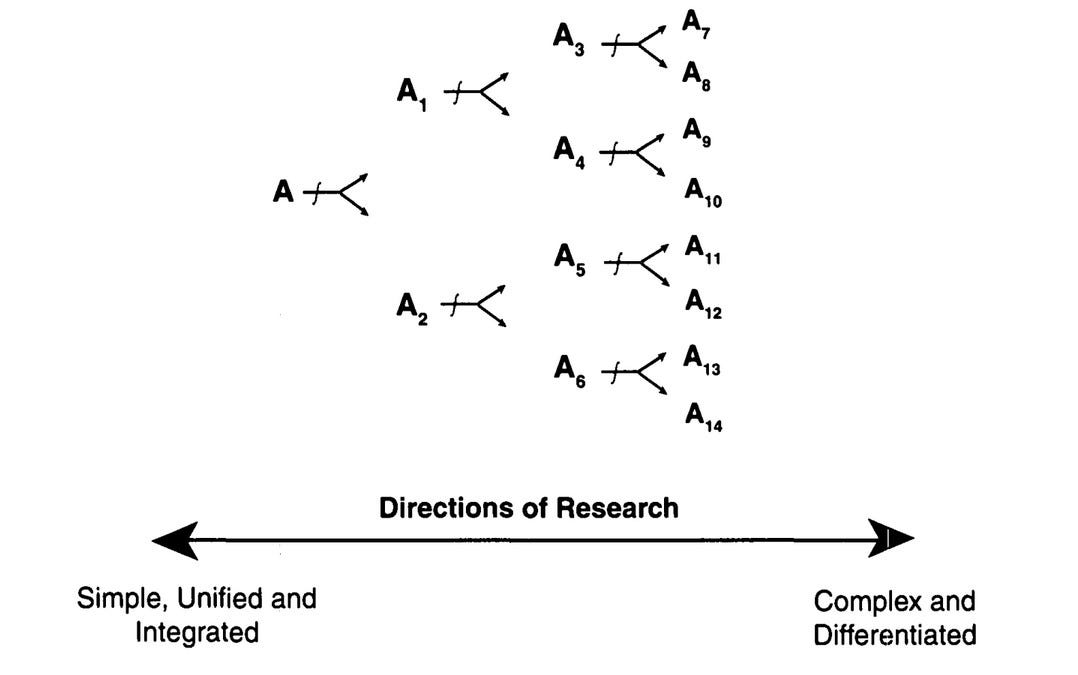
Figure 3
This means that there are two directions of scientific research. We can look at nature in the direction of the more complex, more differentiated functions (to the right in Figure 3), or toward the simpler, unified, and more integrated functions (to the left) (5:11, 7:171-173, 8:111-112). These two directions were inherent in ancient Greek science: One can look at the myriad atoms and their interactions or one can look at the basic laws of nature. Orgonomic science does not differ in this way from this long tradition of Western science.
The key difference that distinguishes Reich's work and the development of orgonomic science from mechanistic science has been orgonomy's focus on the realm of mass-free energy--orgone energy functions. This realm is broader and deeper than the mechanical realm. The mechanical functions, in fact, derive secondarily from primordial orgone energy functions. This helps us understand why the mechanistic approach is so successful with mechanical problems, such as technological invention and the breakdown of matter, while limited when applied to non-mechanical functions, such as psychology, emotions, living processes, the nature of light, weather phenomena, and the creation of matter.
Reich identified mechanism as one of the major forms of armored thought. Its antithesis is mysticism (Figure 4) (9).

While one form of thought may predominate over the other in any armored individual, both are always evident in the presence of armor in what Reich termed "mechano-mystical" thinking. Mechanism views nature as a machine in which each part causes an effect on another, as cogs in a machine. Mysticism views nature as a mysterious unknowable oneness. Reich held that both have been present--overtly or latently-in human thinking since the advent of armor.
Mechanism focuses on the discrete parts of nature (to the right in Fig. 3) and mysticism focuses on the unity of nature (to the left in Fig. 3). It is not the focus on the differentiation, or conversely on the unity, but rather the inflexibility of the view that defines mechanism and mysticism as armored. Armored mechanistic thinking is defined by the rigid application of mechanistic views outside the realm of mechanical functions. For example, viewing a machine as mechanical is functional, but viewing an animal as such is not because living organisms do not function in that way. Similarly, viewing things as unitary is not in itself armored. However, armored mystical thinking is defined by a rigid view of everything as a "mysterious unknowable oneness," accompanied by an inability to see discrete functions which can be known.
Orgonomic functionalism, in contrast, views nature with a perspective that encompasses primary energy functions. Discrete antithetical functions are recognized and also understood as having an identity in relationship to their common functioning principle. The orgonomic approach, therefore, integrates the unitary functions of nature with its differentiated discrete functions. This is illustrated in the two directions of research in Figure 3. This means that it is possible to have objective knowledge of a discrete aspect of nature that is simultaneously anchored in basic comprehensible processes of nature. It also allows for an understanding of common principles and connections between such widely diverse realms as emotions and weather.
Reich's elucidation of the relationship between the observer and that which is observed was a major contribution that further distinguishes orgonomic functionalism from mechanistic and mystical thinking. It is no less than the clarification of the relationship between qualitative (subjective) and quantitative (objective) aspects of phenomena (Figure 5) (7:179-181, 8:118).

Figure 5
Subjective and objective factors are embodied in the two basic elements of the scientific method: observation and experimentation. "Experiment" refers to the process of objectifying a phenomenon. It is instructive to note that it comes from the Latin root "experiri," meaning to "try out," which is also the root of the word "experience" (Figure 6) (1:644-645).

Figure 6
In English, "experience" refers to the subjective aspects and "experiment" to the objective aspects of "trying out" a phenomenon. The development of scientific knowledge requires both "experience" and "experiment." By including the observer, his structure and sensations, in the scientific process, Reich re-established a balance between the subjective and the objective. He emphasized the importance of suspending a conclusion until the weight of subjective experiences impressed on the observer a pattern inherent in his observations. This pattern could then be objectified by experimentation (9).
To objectify a subjective impression by experiment, it is essential to clearly define the realm of investigation. As previously mentioned, the separation and discernment of realms define an essential aspect of scientific knowledge. However, if the investigation isolates the realm in question from its paired function and, therefore, from its common functioning principle, the result is no more than the collection of unrelated facts cut off from their roots. This limits understanding and inhibits further discovery.
Early in the 20th century, one of the developers of subatomic quantum mechanical theory, Werner Heisenberg, understood the danger of theories without facts and stressed the importance of quantifiable observations. However, he was faced with the problem that subatomic factors can only be observed through indirect means which will themselves influence measurement. In other words, the very act of investigation changes the object under study. This is spelled out in his "uncertainty principle" which represents one of mechanistic science's attempts, albeit incomplete, to address the problem of the relationship between the observer and the observed.
Problems such as the one described by Heisenberg illustrate the importance of understanding this relationship. In Figure 7A, we see an "observed realm of nature" paired with an "observer of nature" having an unknown common functioning principle (CFP). On reflection, it becomes apparent that the unknown CFP is "nature" (Figure 7B) (7:170, 8:110).
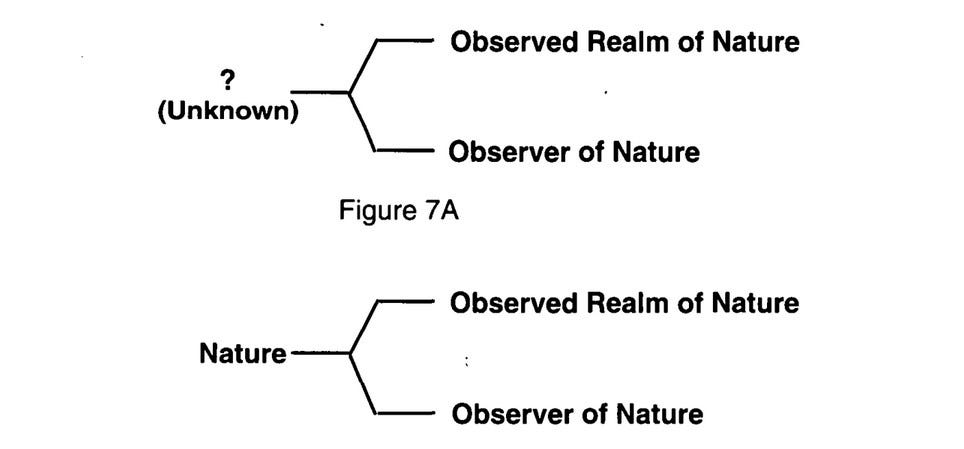
Figure 7B
Mechanism, mysticism and orgonomic functionalism each view and handle the relationship between the elements in this diagram in distinct ways. The mechanistic approach attempts to eliminate subjectivity and obtain entirely objective knowledge by removing the observer from the picture (Figure 8A).

Figure 8A Mechanism
Conversely, the mystical approach merges the observer with nature as a mysterious oneness in which everything is determined by one's subjective experience and belief. This tendency blurs the distinction between between the observer and nature and limits a, focused awareness of a discrete objectifiable realm (Figure 8B).

Figure 8B Mysticism
The functional approach begins with the subjective experience of a discrete realm of nature that is identified, defined, and then objectified. This is accomplished by taking into account the observer's experience while the object of study is concurrently seen in relationship to both the observer and their common functions in nature (Figure 8C).

Figure 8C: Orgonomic Functionalism
We usually think of mystical thinking as being confined to the religious and the poetic, but it is important to bear in mind that it is present, often in disguised form, in conjunction with mechanistic scientific thinking. With its great technical capabilities, mechanistic science has discovered innumerable objective facts. Many of these have been discovered without any awareness of their direct roots in nature. This deficiency has often been bridged by associating or "explaining" these facts with an idea, concept, or theory. Unfortunately, such theories or concepts often take on a life of their own and are then treated as objective reality. Mystical think ing is inherent in the failure to differentiate a subjective impression (idea, concept, theory) from an objective factual reality.
For example, in astrophysics and cosmology, we have "the expanding universe," the "big bang," "black holes," and "dark matter." These theories are based principally on two objective observations: 1) Light spectra from stars and galaxies are almost universally shifted toward the red end of the spectrum. 2) In general, the fainter the light of the object, the greater the shift to the red. The "expanding universe" is invoked to explain these observations. The "big bang" is then invoked to explain the "expanding universe." "Black holes" are invoked to account for observations of quasars that contradict the absolute relationship between brightness and redshift. If there was a "big bang," one would expect the rate of expansion to be slowed by the gravity of matter in the universe tending to draw it back together. "Dark matter" is then invoked to explain the fact that there is not enough visible matter to account for the apparent current slow rate of expansion. While these constructs may be plausible, they remain conjectures that are treated as objective reality.
In biology, we have the "sodium-potassium membrane pump" to explain the factual observation that the concentration of potassium is higher inside the cell than outside, while the concentration of sodium is higher outside than inside, when one would expect them to be equal across the permeable membrane of the cell. Mechanistic biology explains this contradiction with an "exchange pump" that "pumps" sodium out in exchange for potassium "pumped" into the cell, even though there are no direct observations of such a biological entity.
In addition to such theoretical constructs, mechanistic science will often use a few words or a phrase as a concrete reality to explain away an important observation. For example, in medicine it is known that a patient can often reduce pain or other symptoms and even improve healing with out drugs, surgery, or other specific therapy if he believes he is receiving treatment. Mechanistic medicine explains away this important observation as the "placebo effect." Reich cited many other examples such as "air germs" to account for the development of protozoa in grass; "heat waves" to account for the rippling movement in the atmosphere; "cosmic rays" to account for background radiation.
Whenever an idea takes precedence over fact and is not open to revision when faced with observations that contradict it, we are dealing with mysticism rather than scientific inquiry. This is true whether the mystical belief comes in the form or language of religious doctrine, mechanistic scientific theory, or orgonomic scientific theory. Such "science" violates the basic principles of true science. Such theories are often defended with the same vigor as was mystical religious doctrine of the Middle Ages. The history of science is replete with examples of scientists persecuted because their observations and theories contradicted "scientific" dogma. This journal recently published a contemporaneous first person account of a scientist whose observations challenge the "big bang" and "black hole" theories (10).
Mechanical and mystical tendencies in thinking go hand in hand. It is important to identify the ways each tendency is present because both interfere with the acquisition of true scientific knowledge: the mystical by limiting discrete clear focus on a specific realm, and the mechanistic by excluding the observer and, therefore, direct contact with nature (Figure 8). This functional diagram also illustrates Reich's observations that the mechanist is cut off from core contact (his roots in nature) while the mystic has distorted core contact (9).
Restating the scientific method in terms of subjective and objective properties, we can say that true science must begin with a subjective experience of some phenomenon in nature. These observations must then be focused so that a discrete realm of investigation can be identified. A conclusion must be suspended until there is sufficient observation to al low a pattern to emerge, because a premature conclusion will be derived from the observer rather than from the phenomena themselves. The pattern that emerges from the observations (the hypothesis) will define the aspect or aspects of the phenomena to be objectified through experimentation. The process of experimentation will lead, in turn, to new observations that will confirm the pattern or require modifications in the conclusions. Each stage of this process is essential for the development of functional scientific knowledge. Orgonomic science's acknowledgement of the importance of subjective sensory experience breathes life and excitement back into the objective scientific world.
To return to the wonderment that children have in science: There is no question that as children our subjective experiences are primary and that we then broaden our view to see things more objectively. For example, as a child, I felt expansive in fair weather and wanted to go play outside. In rainy weather, I felt quiet and drawn into myself, wanting to withdraw with a board game or a book. I also enjoyed watching the changing clouds and their patterns. I began to know that weather changes were correlated with specific types of clouds which were objectively described and illustrated in books, and that these changes in the weather mechanistic science, but largely remain as isolated observations removed from our subjective experience.
From basic orgonomic principles, we know that the function of pulsation occurs widely in nature. In the emotional realm, we experience the alternation between expansive and contractive emotions (Figure 9).

Figure 9
In the non-living realm, we can see that pulsation of the atmospheric energy is the common functioning principle of the alternating antithesis of fair weather (high barometric pressure) systems and stormy weather (low barometric pressure) systems (Figure 10) (11).
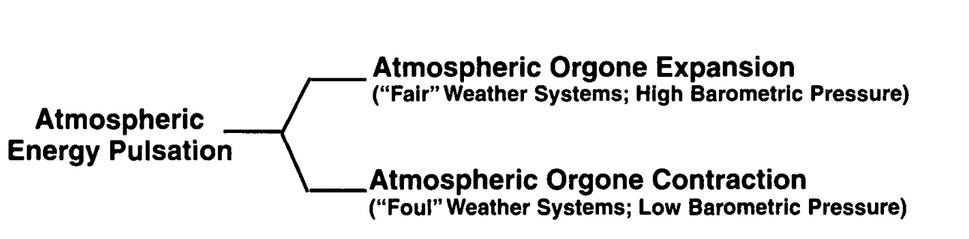
Figure 10
"Fair" weather is subjectively experienced as expansive, and "foul" weather as contractive. These subjective impressions of the state of the atmospheric orgone have been objectified by thermal and electroscopic measurement (12, 13). The theory that weather formations occur as a consequence of pulsations in the planetary orgone energy streams makes observations of the weather all the more exciting because it connects our own individual emotional pulsation with the larger objective reality of atmospheric energy pulsations.
To summarize, orgonomic science has its roots in a long tradition of scientific method dating back to the ancient Greeks. While orgonomy is established on this ancient scientific tradition, it is unique in its direct focus on mass-free, primordial (orgone) energy functions. In order to work in this realm, it was necessary for Reich to elucidate several principles unique to orgonomic science. These have included: 1) developing the principle of the simultaneous antithesis and identity of functions in nature, 2) clarifying the relationship and relative emphasis of subjective and objective factors, and 3) clarifying the nature of the relationship between the observer and the object of study.
The articles that follow illustrate various aspects of what has been introduced here. Some may focus primarily on subjective experiences of phenomena while others may focus on the more objective aspects. It is important to keep in mind that subjective impressions are an essential early stage in the development of new knowledge. I want to also emphasize that the direction of research can be either toward the more differentiated individual aspects of a phenomenon or toward more unified common functioning principles. Both are essential avenues for developing scientific knowledge.
REFERENCES
1. Soukhanov, A.H. ed.: American Heritage Dictionary. Boston: Houghton Mifflin Co., 1992.
2. Porter, R. ed.: Man Masters Nature: Twenty-Five Centuries of Science. New York: George Braziller, 1988.
3. Grant, E.: Physical Sciences in the Middle Ages. New York: John Wiley & Sons, Inc., 1971.
4. Motz, L. and Weaver, J. H.: Tbe Story of Physics. New York: Plenum Press, 1989.
5. Reich, W.: "Orgonomic Functionalism, Part II, On the Historical Development of Orgonomic Functionalism," Orgone Energy .Bulletin, 2:1-15, 1950.
6. Reich, W.: Function of the Orgasm, Tbe Discovery of the Orgone. trans. Wolfe, T. P. New York: Orgone Institute Press, 1942.
7. Reich, W.: "Orgonometric Equations: I. General Form," Orgone Energy Bulletin, 2:161-183, 1950.
8. Meyerowitz,].: "Basic Orgonometry," Journal ofOrgonomy, 19:92-121, 1985.
9. Reich, W.: Ether, God and Devil. Rangeley, Maine: Orgone Institute Press, 1949. Retranslated and republished: New York: Farrar, Straus & Giroux, 1973.
10. Arp, H.: "The Sociology of the Controversy," Journal of Orgonomy, 27:113-123, 1993.
11. Blasband, R. A.: "Orgonomic Functionalism in Problems of Atmospheric Circulation (Part I Normal Atmosphere)" Journal of Orgonomy, 3:166-187, 1969.
12. Rosenblum, C. F.: "The Electroscope (Part III), Atmospheric Pulsation," Journal of Orgonomy, 10:57-80, 1976.
13. Konia, C.: "Thermal Properties of the ORAC (Part II)" Journal of Orgonomy, 12:244-252, 1978.
Great read! It’s important to come back to the foundations of the scientific method. Being able to hypothesize, test, and falsify is what makes science so robust.